
Heads up: TerrierBeagleLab may earn a small commission from qualifying purchases made through links in this article, at no extra cost to you. We only recommend products we believe are genuinely useful for Jack Russell, Beagle, and Labrador owners.
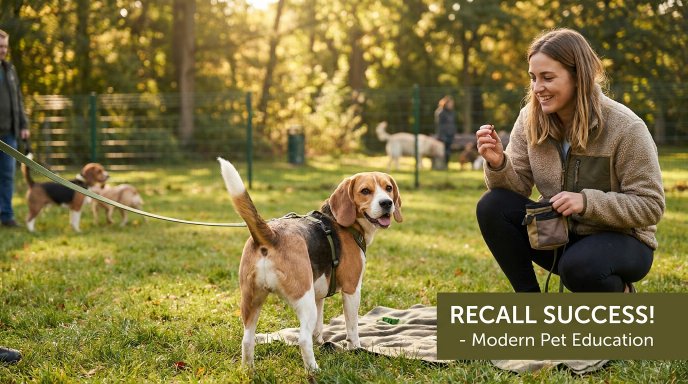
Recall is hard for Beagles because scent is powerful, not because the breed is incapable. A Beagle that ignores you usually is not being rude. The environment is simply paying better. Strong recall comes from practice, management, and rewards that are valuable enough to beat the next smell.
- Quick Answer
- Why Recall Feels So Hard With Beagles
- Rule 1: Do Not Practice Recall Off Leash Too Early
- Rule 2: Make Coming to You Extremely Worthwhile
- Rule 3: Choose a Clear Recall Cue
- How to Build Recall Step by Step
- Use These Recall Games
- What to Do When Your Beagle Ignores You
- Do Not Poison the Recall Cue
- A Practical Beagle Recall Routine
- Safety Matters
- Final Takeaway
Quick Answer
The most effective Beagle recall training tips are to start on a long line, reward heavily for every successful return, avoid calling when you cannot enforce the cue, and build the skill gradually around distractions. Reliable recall is possible, but it has to be trained with hound instincts in mind.
Why Recall Feels So Hard With Beagles
Beagles are scent hounds. That means the nose can pull attention away from voices, toys, and even familiar routines. Many owners assume the dog is ignoring them on purpose, but what is really happening is competition. Smells are intensely reinforcing. If your recall cue is weaker than the scent trail, your Beagle will choose the trail.
That does not mean you should give up. It means recall training has to be built like a high-value habit, not treated like a one-time command.
Rule 1: Do Not Practice Recall Off Leash Too Early
The safest shortcut is to stop taking shortcuts. Use a long line in a fenced area or open space where it is legal and safe. A 15- to 30-foot line gives your Beagle freedom to move while still letting you prevent the reward of running off. If your dog learns that “come” is optional, training gets harder.
Rule 2: Make Coming to You Extremely Worthwhile
Recall rewards should feel special. Use soft, tiny, high-value treats, a favorite toy, praise with energy, or a quick game if your dog likes interaction. Many Beagles respond best when the reward is immediate and generous. In early training, pay every success.
You are not bribing the dog. You are building a strong history that says running back to you is one of the best choices available.
Rule 3: Choose a Clear Recall Cue
Use one word consistently, such as “come” or “here.” Say it once in a bright tone, then help your dog succeed. Move backward, clap lightly, crouch, or jog away. Motion often helps more than standing still and repeating the cue. When the dog gets to you, reward right away.
If you know your Beagle is unlikely to respond, do not use the cue just to test it. Go get the dog, shorten the distance, or lower the distraction instead.
How to Build Recall Step by Step
Stage 1: Indoors
Start in a quiet room. Call your Beagle from a few feet away, reward, and release. Keep it playful. Do several easy repetitions over a few days.
Stage 2: Around the house
Practice from room to room, from the yard gate to the back door, or from a short distance in the hallway. Reward every time. This stage helps the dog learn that recall matters in everyday spaces, not just in a formal session.
Stage 3: Yard or fenced area with a long line
Now add mild distractions. Let your Beagle sniff. Then call once, move away, and reward a fast response. If the dog does not come, gently guide with the line and make a note that the distraction was too hard.
Stage 4: Controlled outdoor practice
Increase difficulty slowly. Practice at parks during quiet times, on trails with room, or in open fields where your Beagle can smell interesting things without becoming overwhelmed. A stronger environment requires stronger rewards.
Use These Recall Games
- Ping-pong recall: two people take turns calling the dog and rewarding each success.
- Find me: hide lightly behind a doorway or tree and call your dog to encourage seeking you out.
- Chase me: call, then jog away so your Beagle follows motion.
- Check-in jackpot: reward spontaneous returns during walks, even when you did not call.
What to Do When Your Beagle Ignores You
Stay calm. Do not turn recall into a punishment. Avoid chasing unless safety requires it, because that can become a game. Instead, use your long line, create movement away from the distraction, or make the environment easier next time. Ask yourself what your dog was learning level-wise. Were you too close to a scent, another dog, wildlife, or exciting foot traffic?
Do Not Poison the Recall Cue
Owners often call the dog only for things the dog dislikes, such as bath time, nail trims, or leaving the park. Make sure recall also predicts good things. Call your Beagle, reward, and then let the dog go back to sniffing sometimes. That keeps the cue from feeling like the end of fun.
A Practical Beagle Recall Routine
A solid weekly routine might include one short indoor session, two yard sessions, and two outdoor long-line sessions. Keep each one brief. Success matters more than volume. Five good recalls are more useful than fifteen sloppy ones.
Safety Matters
Even well-trained Beagles can struggle off leash around strong scents, wildlife, and unfenced areas. Reliable recall should increase freedom, but safety should still guide your decisions. Many owners choose fenced spaces or long-line adventures for life, and that is a responsible choice.
Final Takeaway
The Beagle recall training tips that actually work are the ones that respect the breed. Do not fight the nose. Train around it. Pay well, practice smart, use a long line, and build the skill in layers. A Beagle may never become the easiest off-leash breed, but that does not mean your recall cannot become much more reliable and useful in everyday life.