
Heads up: TerrierBeagleLab may earn a small commission from qualifying purchases made through links in this article, at no extra cost to you. We only recommend products we believe are genuinely useful for Jack Russell, Beagle, and Labrador owners.
Labradors are often eager, social, and food-motivated, which gives owners a strong starting point for obedience work. The challenge is usually not willingness. It is excitement. A Lab can know what you want and still struggle to stay calm enough to do it well. Home training works best when it combines structure, repetition, and simple daily wins.
- Quick Answer
- Why Home Training Works Well for Labradors
- Start With the Right Setup
- The Best First Behaviors to Teach
- Use Daily Life as Part of Training
- A 10-Minute Home Routine
- How to Handle a Bouncy or Pushy Lab
- Common Owner Mistakes
- What About Older Puppies and Adult Rescue Labs?
- When to Add Distractions
- Final Takeaway
Quick Answer
Labrador Retriever obedience training at home works best when you build short daily sessions around practical behaviors like sit, down, stay, place, leave it, and polite greetings. Labs usually learn quickly when you use food rewards, clear markers, and consistent routines.
Why Home Training Works Well for Labradors
Labradors tend to enjoy interaction and often like working with people. That makes home training a realistic option for many owners. You do not need complicated equipment or long classes to start. What you do need is consistency. Labs are strong dogs, and small manners problems become big ones when they are repeated every day.
Training at home lets you teach skills where they matter most: at doors, around the kitchen, during greetings, and in the living room when excitement builds.
Start With the Right Setup
Pick one marker word such as “yes” or use a clicker. Have soft treats ready. Train when your dog is not wildly excited. For energetic Labradors, a short sniff break or light walk before training can improve focus. You do not want the dog exhausted, but you do want the edge taken off.
The Best First Behaviors to Teach
1. Sit
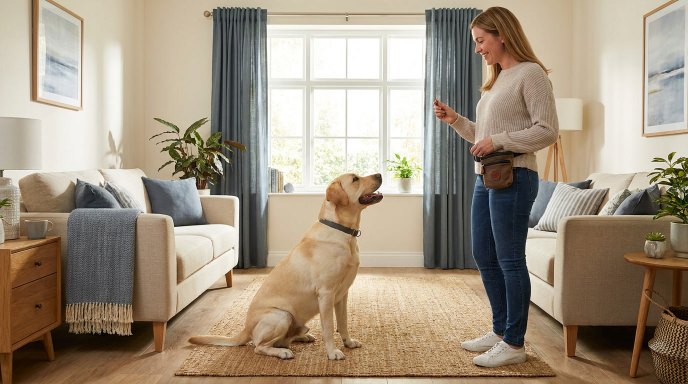
Sit is useful for greetings, doors, meals, and impulse control. Lure the nose up and slightly back, mark when the rear touches the ground, and reward. Then quickly start asking for it in real life instead of practicing only in drill format.
2. Down
Down helps Labs settle. Lure slowly from sit to the floor, mark, reward, and keep your timing clean. Do not force the dog into position.
3. Place
Teaching your Lab to go to a bed or mat is one of the most practical skills for home life. It helps with guests, kitchen supervision, and overexcitement. Reward the dog for getting on the mat, then for staying there calmly.
4. Leave it
Labradors often investigate with their mouths. Leave it builds self-control around food, dropped items, and household clutter. Begin with a low-value item in your hand and reward the dog for disengaging.
5. Wait at doors
This is not just about politeness. It is also a safety skill. Teach your dog to pause before crossing thresholds so door dashing does not become a habit.
Use Daily Life as Part of Training
The easiest way to improve Labrador obedience training at home is to stop separating “training time” from normal life. Ask for a sit before the leash goes on. Ask for a place before dinner prep. Reward calm waiting before throwing a toy. These moments add up quickly and create habits that feel natural instead of forced.
A 10-Minute Home Routine
- One minute of engagement: name response, hand target, eye contact.
- Two minutes of sits and downs with quick rewards.
- Two minutes of place training on a bed or mat.
- Two minutes of leave it practice with easy setups.
- Two minutes of calm greeting or leash clipping work.
- One minute of easy wins and a cheerful finish.
That short routine, repeated often, is enough to move behavior in the right direction.
How to Handle a Bouncy or Pushy Lab
If your Labrador becomes too excited, lower the energy of the session. Use slower delivery, simpler tasks, and more mat work. Many Labs struggle because they have learned that attention always means excitement. Show your dog that rewards can also happen for calmness, waiting, and soft body language.
Common Owner Mistakes
- Training only when there is a problem instead of building habits daily.
- Talking too much and making cues muddy.
- Moving too fast from kitchen success to front-door chaos.
- Rewarding only active behaviors and forgetting to reward calm.
- Expecting a young Labrador to have adult self-control.
What About Older Puppies and Adult Rescue Labs?
Home obedience training still works. Start at the dog’s current skill level instead of assuming the basics are in place. Many adult Labs know cues in one context but not another. Re-teaching with structure is not a step backward. It is the fastest way to create reliability.
When to Add Distractions
Add distractions only after your dog is successful in quiet spaces. Start with mild changes, such as another family member moving through the room or practicing near the open back door. If behavior falls apart, reduce the challenge and rebuild.
Final Takeaway
Labrador Retriever obedience training at home does not have to be complicated. The most effective approach is simple, consistent, and built into daily life. Focus on a few practical skills, keep sessions short, reward generously, and reinforce calm behavior as often as you reinforce action. For most Labs, that combination creates noticeable progress quickly.