
Heads up: TerrierBeagleLab may earn a small commission from qualifying purchases made through links in this article, at no extra cost to you. We only recommend products we believe are genuinely useful for Jack Russell, Beagle, and Labrador owners.
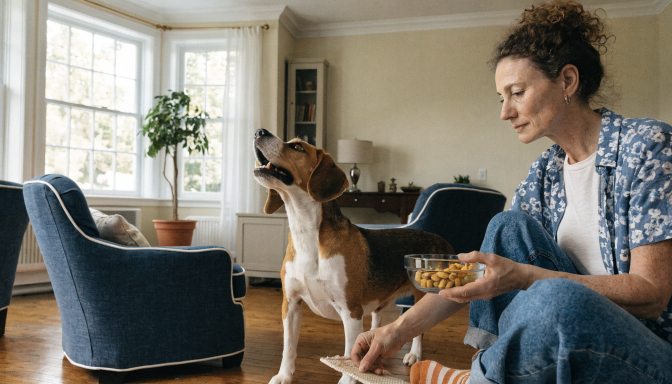
Beagles are vocal for real reasons. They bark when they are under-stimulated, over-excited, tracking sounds or scents, frustrated by barriers, or simply doing what hounds were bred to do. The goal is not to silence your dog completely. The goal is to understand the trigger, lower unnecessary barking, and teach a calmer alternative that your Beagle can actually repeat.
- Quick Answer
- Why Beagles Bark So Much
- Start With a Barking Trigger Checklist
- Reduce the Trigger Before You Train
- Teach a Calm Alternative
- Use Enrichment to Lower Daily Noise
- Do Not Accidentally Reward Barking
- What About “Quiet” Training?
- If Barking Happens When You Leave
- Common Mistakes
- A Practical Daily Plan
- Final Takeaway
Quick Answer
To stop a Beagle from barking excessively, first identify the reason for the barking, then use management, enrichment, and calm training to reduce the trigger and teach an alternative behavior. Most Beagles improve when owners stop reacting to barking as a single problem and start treating it as a pattern with specific causes.
Why Beagles Bark So Much
Beagles are scent hounds, and vocal behavior is part of the breed package. Some bark at sounds, some bark when they are frustrated, some bark when left alone, and some bark because they are bored and underworked. That means the first question is not “How do I make my dog stop?” It is “What is my dog trying to do or communicate right now?”
Once you know the pattern, you can build a realistic plan.
Start With a Barking Trigger Checklist
Watch when the barking happens and write it down for a few days. Common triggers include:
- people walking past the window
- outside noises or neighborhood dogs
- excitement before walks or meals
- barrier frustration at doors, gates, or fences
- boredom during long inactive periods
- being left alone too quickly
- scent arousal in the yard
A barking log helps you see patterns that are easy to miss in the moment.
Reduce the Trigger Before You Train
If your Beagle barks at the front window all day, training will not go far unless you change the setup. Use frosted window film, close curtains, move furniture away from lookout spots, or create distance from the trigger. If barking happens when your dog is bored, more enrichment may matter before formal training does.
Management is not cheating. It is what makes training possible.
Teach a Calm Alternative
Many owners tell the dog what not to do but never teach what to do instead. A better plan is to teach a replacement behavior such as going to a mat, turning toward you, or targeting your hand when a mild version of the trigger appears.
A simple pattern to teach
- Notice a low-level trigger before barking starts.
- Mark the moment your dog looks at the trigger calmly.
- Reward your Beagle for turning back to you.
- Repeat until checking in becomes more automatic.
- Then add a cue such as “mat” or “with me.”
Use Enrichment to Lower Daily Noise
Beagles often bark more when their brain and nose are underused. Add sniff walks, scatter feeding, snuffle mats, short nose work games, and food puzzles. A Beagle that gets to use natural scenting behavior productively is often less likely to create its own noisy job indoors.
Do Not Accidentally Reward Barking
Sometimes barking works. If barking gets your attention, opens a door, starts the walk, or causes you to hand over food, the habit becomes stronger. That does not mean you should ignore every bark. It means you should separate real needs from learned noise and reward calm behavior before the barking escalates.
What About “Quiet” Training?
You can teach a quiet cue, but it works best after you understand the cause of the barking. Wait for a natural pause, say “quiet,” reward the pause, and keep sessions easy. The cue is a support tool, not a substitute for solving boredom, anxiety, or barrier frustration.
If Barking Happens When You Leave
If your Beagle barks mainly when alone, the issue may be isolation distress or separation-related stress, not simple nuisance barking. In that case, independence training, departure routines, and sometimes professional help are more useful than telling the dog to be quiet.
Common Mistakes
- Yelling over the barking, which can sound like joining in.
- Using punishment without changing the trigger.
- Expecting a bored Beagle to stay quiet for long stretches.
- Practicing around full-strength triggers too early.
- Ignoring the difference between alert barking and anxiety barking.
A Practical Daily Plan
Try one morning sniff walk, one midday enrichment block, one short session teaching mat work, and one small environment change that reduces common triggers. That kind of simple routine often helps more than one big training session.
Final Takeaway
If you want to stop a Beagle from barking excessively, focus less on suppression and more on cause, structure, and replacement behavior. Beagles are vocal dogs, but they are not hopeless dogs. When you reduce triggers, meet the breed’s needs, and reward calm patterns consistently, barking usually becomes much more manageable.