
Heads up: TerrierBeagleLab may earn a small commission from qualifying purchases made through links in this article, at no extra cost to you. We only recommend products we believe are genuinely useful for Jack Russell, Beagle, and Labrador owners.
A hyperactive Jack Russell usually is not too energetic to train. More often, the dog is under-structured, over-aroused, or missing the right mix of physical exercise, mental work, and recovery time. Calming the breed is less about wearing the dog out completely and more about teaching the dog how to shift down after activity.
- Quick Answer
- Why “More Exercise” Is Not the Whole Answer
- Look at the Full Daily Picture
- Use a Better Activity Mix
- Teach an Off Switch
- Watch for Trigger Stacking
- Use Food and Scent to Slow the Brain Down
- Common Mistakes
- A Sample Calmer-Day Routine
- When Hyperactivity Might Be More Than Normal Breed Energy
- Final Takeaway
Quick Answer
To calm a hyperactive Jack Russell, build a daily routine that combines exercise, enrichment, impulse-control training, and intentional rest. Many Jack Russells get calmer when owners stop chasing endless tiredness and start teaching the dog how to settle after appropriate activity.
Why “More Exercise” Is Not the Whole Answer
Jack Russells do need outlets, but nonstop high-intensity activity can create a fitter, more frantic dog. If every day becomes a cycle of arousal and excitement, the dog may get better at being revved up instead of better at calming down. The goal is balanced input: movement, brain work, and recovery.
Look at the Full Daily Picture
Ask yourself a few questions. Does your dog get sniffing opportunities or only fast-paced exercise? Are there calm transitions between activities? Does your dog ever practice lying quietly on a mat, or only action-based behaviors? Hyperactivity often improves when the day stops feeling random.
Use a Better Activity Mix
- structured walks with sniffing time
- short training sessions
- food puzzles or scatter feeding
- tug with rules
- beginner agility-style work
- mat training and settle practice
The calmest Jack Russells are often the ones getting the most balanced routines, not the most chaotic ones.
Teach an Off Switch
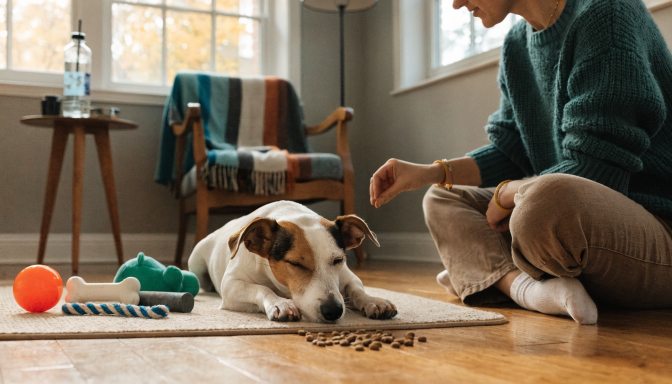
Settling is a skill. Start by rewarding your dog for standing calmly on a mat, then sitting, then lying down, then staying there for a few seconds. Gradually build duration. Use calm praise and small treats. Many terriers need repeated practice learning that stillness can be rewarding too.
Watch for Trigger Stacking
A busy day can build up arousal in layers. Visitors, barking at the window, exciting walks, rough play, and missed naps can all stack together until your dog seems unable to switch off. If your Jack Russell has an especially chaotic day, lower the intensity later on instead of adding more stimulation.
Use Food and Scent to Slow the Brain Down
Fast games create excitement. Sniffing and foraging often create calmer engagement. Scatter a meal in the grass, use a snuffle mat, hide treats in simple boxes, or offer a puzzle feeder. These activities give the terrier brain a job without always pushing the arousal level higher.
Common Mistakes
- Turning every play session into maximum intensity.
- Expecting naps without helping the dog decompress first.
- Giving too little structure between exciting events.
- Rewarding frantic behavior with immediate attention.
- Confusing overtired behavior with extra energy.
A Sample Calmer-Day Routine
Start with a morning walk that includes sniffing, follow with breakfast in a puzzle feeder, then a short rest period. Add one midday training block and one brief play session with rules. In the evening, use mat work, a chew, or a quiet enrichment activity instead of another high-adrenaline game.
When Hyperactivity Might Be More Than Normal Breed Energy
If your dog seems unable to rest, is constantly scanning, pacing, vocalizing, or escalating despite a thoughtful routine, talk with a qualified trainer or veterinarian. Sometimes pain, chronic stress, or bigger behavior issues can show up as nonstop motion.
Final Takeaway
If you want to calm a hyperactive Jack Russell, think beyond exercise alone. This breed usually needs structure, outlets, and deliberate calmness practice. Once the dog learns that not every moment leads to more excitement, household behavior often becomes much easier to live with.